When Adhesive Attachment Is the Right Choice
Adhesive-backed nameplates simplify installation. No drilling holes, no rivets, no welding, no mechanical fasteners to align and secure. For most equipment, panels, and enclosures, a properly specified adhesive nameplate bonds in seconds and stays put for years.
Adhesive nameplates work well for:
- High-volume assembly lines where drilling or riveting every unit would slow production
- Sealed or watertight enclosures where drilling mounting holes would compromise the seal
- Thin-gauge equipment housings that can't accept rivets or screws
- Smooth finished surfaces: Painted, powder-coated, plastic, glass, stainless; where adhesive bonds reliably
- Retrofit and field identification where equipment is already installed and drilling isn't practical
- Low-to-moderate-exposure service environments: Indoor, outdoor with limited chemical exposure, moderate temperature ranges
For applications where mechanical attachment is mandatory (high-vibration environments, high-temperature service, or high-security installations where tamper resistance matters) we also produce industrial nameplates with mounting holes for rivets, screws, or welded attachment.
Gallery
Adhesive Options
Not all adhesives are equivalent. The right adhesive depends on the substrate the nameplate bonds to, the service environment, and the expected life of the installation.
- Standard pressure-sensitive adhesive: General-purpose acrylic adhesive suitable for most indoor and moderate outdoor applications. Bonds well to smooth metal, most plastics, glass, and painted surfaces. Good temperature range for typical industrial service.
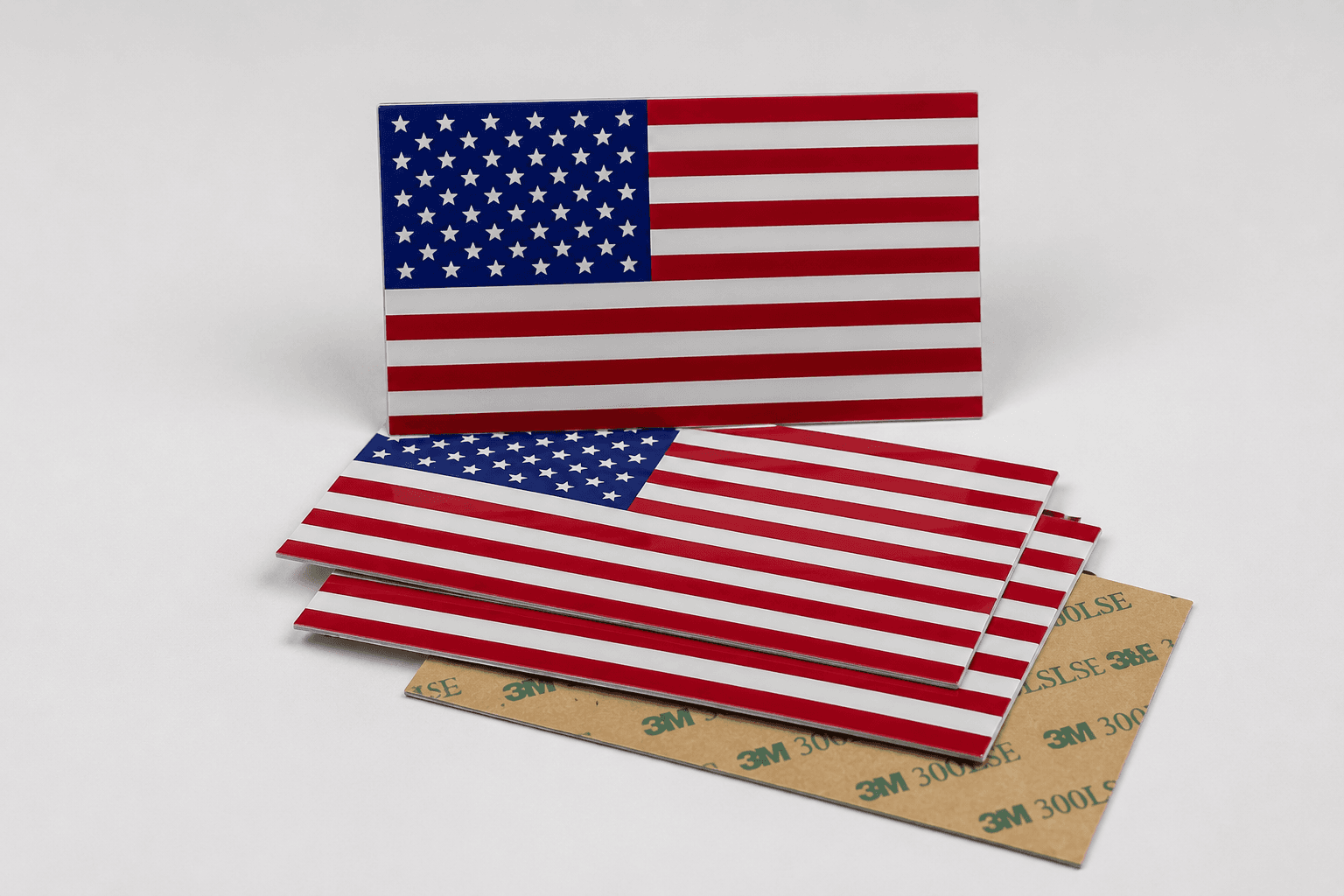
- 3M VHB (Very High Bond) acrylic: Higher-bond adhesive suitable for demanding applications. Excellent long-term durability, wider temperature range, resists weather and UV. Appropriate for outdoor installations, temperature-cycling environments, and applications where the nameplate may see mechanical loading.
- High-temperature adhesive: For applications where service temperatures exceed the range of standard acrylics. Specify your temperature requirement at the quote stage and we'll match the adhesive.
- Tamper-evident adhesive: Leaves a visible "VOID" pattern or destructs if the nameplate is removed. Used for security, warranty-void, and tamper-detection applications.
- Chemical-resistant adhesive: For applications with solvent or cleaning-chemical exposure where standard acrylics would soften or fail.
- Low-surface-energy (LSE) adhesive: For bonding to polyethylene, polypropylene, and other hard-to-bond plastics where standard adhesives won't hold.
We'll recommend the right adhesive based on your application at the quote stage.
Substrate Options for Adhesive Nameplates
Adhesive nameplates can be produced on any substrate we offer:
- Aluminum and anodized aluminum: Most common for adhesive applications. Thin substrates (.012" – .032") are ideal for adhesive backing because they're light, flexible enough for slight curves, and bond well.
- Stainless steel: Less common for adhesive but available, typically in thinner gauges to keep weight down. Heavy stainless plates generally use mechanical attachment.
- Foil / lightweight: Thin aluminum or stainless foil substrates for lightweight asset tagging.
- Polyester and polycarbonate: Flexible plastic substrates for applications where metal isn't required and flexibility matters.
Compliance and Certifications
Adhesive nameplates from Holland Nameplate are produced under our ISO 9001:2015 certified quality management system. Adhesive constructions commonly support:
- UL Recognized Component Labels — UL 969 includes specific tests for adhesive permanence; our UL-authorized adhesive nameplate constructions have been evaluated for these requirements
- MIL-STD-130 UID nameplates with adhesive attachment where mechanical attachment isn't practical (note: DoD sometimes requires supplemental mechanical attachment for certain applications — verify your contract requirements)
- ASME, ANSI, NEMA, and ASTM standards where adhesive attachment is permitted for the specified application
Frequently Asked Questions
Depends on adhesive, substrate bonded to, and environment. Standard pressure-sensitive acrylics on smooth metal in typical indoor environments hold for the life of the equipment; decades. Standard acrylics on painted surfaces or in outdoor environments may eventually fail. 3M VHB acrylic in demanding outdoor applications, including freeze-thaw cycling, holds for 10+ years in our experience. For mission-critical applications where adhesive failure would be expensive, we recommend supplemental mechanical attachment.
Standard acrylic adhesives bond well to smooth metal (aluminum, steel, stainless), most painted surfaces, glass, and many plastics (ABS, PVC, acrylic). They bond less well to polyethylene, polypropylene, silicone rubber, and low-energy plastics — for these, specify low-surface-energy adhesive.
Standard adhesive attachment can be removed (typically destroying the nameplate in the process, which itself is a form of tamper evidence). For higher tamper resistance, specify tamper-evident adhesive (leaves visible VOID pattern) or combine adhesive with mechanical attachment.
We produce adhesive nameplates as thin as .012" aluminum for lightweight asset tagging. Thinner substrates are more flexible and conform to slightly curved surfaces but are less rigid when handled. Typical adhesive nameplate thickness for industrial applications is .020" to .032".
Yes. Proper surface prep and application pressure are the main requirements. We can include application instructions with orders where useful.
Standard acrylic adhesives typically have service temperature ranges of approximately -40°F to 200°F. For higher-temperature service (engine compartments, exhaust systems, furnaces), specify high-temperature adhesive.
Yes. As a UL Authorized Supplier, we produce UL Recognized Component Labels with adhesive backing per UL-qualified constructions.
Request a quote for adhesive nameplates
Send us your specification and we'll reply with pricing and lead time.